Documentation
SpeakUp: AI-Powered Voice English Speaking Coach
1. What Is SpeakUp?
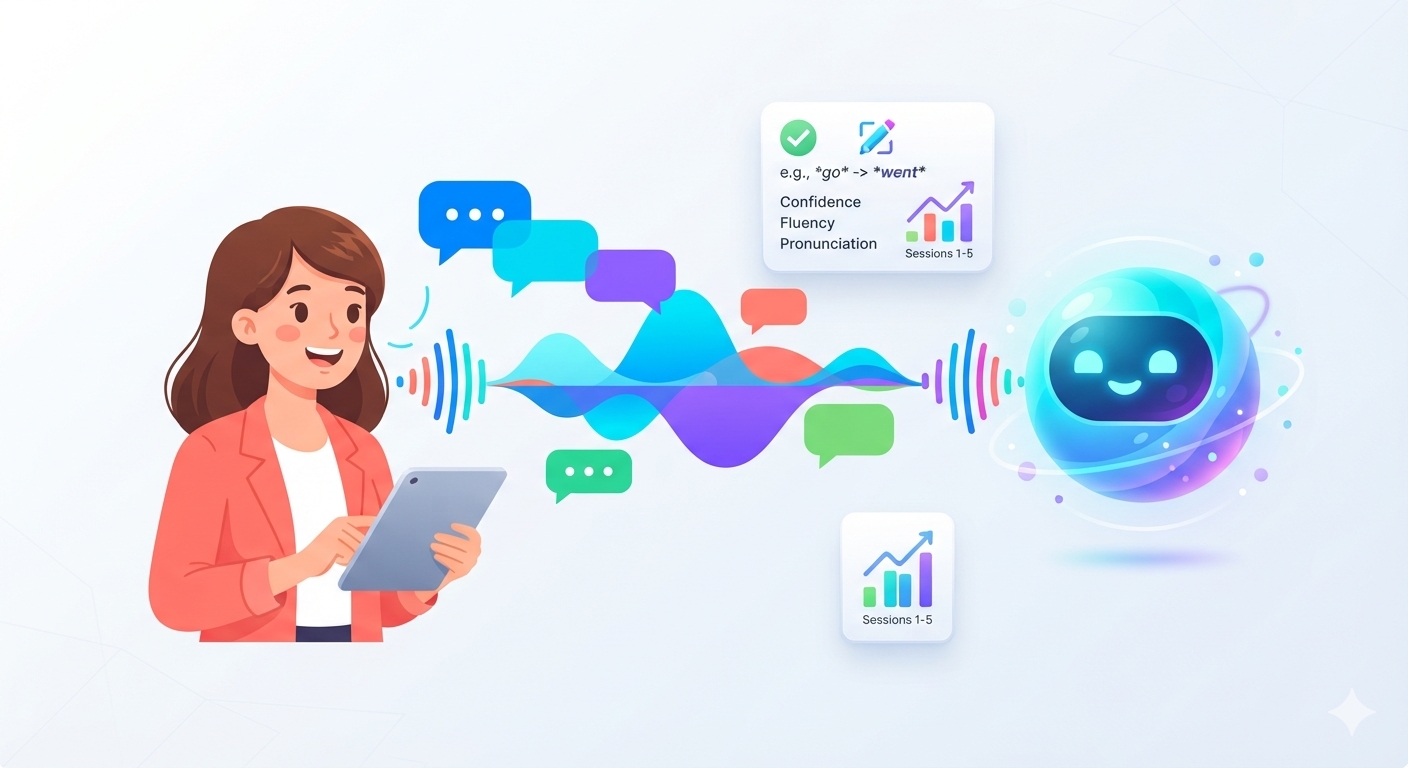
SpeakUp is an AI-powered English speaking practice platform that lets learners have natural, flowing voice conversations with an intelligent AI conversation partner — then receive a detailed, personalized evaluation of their actual speaking performance after each session.
The name captures the essence of the project in one powerful word:
- Speak — the core activity every English learner needs to practice
- Up — the direction of improvement, confidence, and progress
SpeakUp is not a chatbot. It is not a grammar checker. It is not a flashcard app. It is a complete speaking practice ecosystem that separates the experience of conversation from the science of evaluation — allowing learners to speak freely and confidently without interruption, while still receiving rigorous, evidence-based feedback afterward.
2. The Problem It Solves
The Silent Struggle of English Learners
Millions of people study English for years — reading textbooks, memorizing vocabulary, completing grammar exercises — yet still freeze when asked to speak. The reason is simple: they never get enough real speaking practice, and when they do speak, no one gives them detailed, honest feedback.
Traditional language learning has three critical gaps:
| Gap | What's Missing | Consequence |
|---|---|---|
| Practice Gap | No available conversation partner at any hour | Learners speak rarely, if ever |
| Feedback Gap | No detailed analysis of how they actually speak | Errors and habits go unnoticed for years |
| Confidence Gap | Fear of judgment from human partners | Learners avoid speaking altogether |
Existing apps partially address these gaps. Some offer scripted dialogues. Some offer pronunciation drills. Some offer AI chatbots that correct every sentence in real time — which often increases anxiety and destroys conversational flow.
SpeakUp's Insight
The moment of conversation and the moment of correction should be separated.
When you're speaking, you need a patient, encouraging partner who lets you finish your thoughts. When you're done, you need a rigorous analyst who tells you the truth about your grammar, vocabulary, fluency, and habits.
No existing tool does both well. SpeakUp does.
3. How It Works — The Complete User Journey
Step 1: Sign Up and Set Your Goal
The learner creates an account and sets a target — for example, "I want to speak confidently in job interviews" or "I want to sound natural in everyday conversation." This shapes everything that follows.
Step 2: Choose a Conversation Scenario
The learner picks a topic or scenario: free conversation, travel, workplace situations, interviews, technology, daily life, or a custom topic. They also choose a difficulty level.
Step 3: Speak Freely
The learner presses the microphone button and simply talks. The AI responds naturally — asking follow-up questions, showing interest, keeping the conversation alive — without interrupting to correct mistakes. This is the core experience: a safe, judgment-free space to speak.
Step 4: The Session Ends
When the learner is finished, they end the session. The full transcript, timestamps, and relevant metadata are stored securely.
Step 5: The Evaluation Begins
Behind the scenes, an evaluation pipeline analyzes the entire conversation. This is where the real learning happens.
Step 6: The Personalized Report Arrives
The learner receives a comprehensive report covering:
- Grammar Analysis — every error, with the original sentence, the corrected version, the error category, and a plain-language explanation
- Vocabulary Analysis — repeated words, overly simple word choices, and stronger, more natural alternatives
- Natural Expression Upgrades — how to say the same thing more idiomatically, formally, or casually
- Fluency Metrics — speaking rate, filler words ("um," "uh," "like"), pauses, and hesitation patterns
- CEFR-Oriented Level Estimate — a non-official estimate (A1–C2) using CEFR descriptors as a reference framework
- Strengths and Weaknesses — what the learner did well and what needs work
- Personalized Learning Plan — specific, prioritized recommendations based on their actual performance
Step 7: Track Progress Over Time
The learner's dashboard shows score trends, recurring grammar issues, vocabulary growth, and session history — turning isolated practice into measurable improvement.
4. What Makes SpeakUp Different
The Separation Principle
Most AI language tools make the same mistake: they correct in real time. This seems helpful but is actually counterproductive. Constant correction:
- Breaks conversational flow
- Increases anxiety and self-consciousness
- Prevents learners from developing spontaneous fluency
- Focuses attention on errors rather than communication
SpeakUp inverts this. During conversation, the AI is a supportive partner. After conversation, the system is a rigorous analyst. This mirrors how humans actually learn to speak — you talk freely, then reflect on how you did.
Evidence-Based Feedback
SpeakUp doesn't just say "good job" or "try again." It produces specific, actionable, evidence-based feedback tied directly to what the learner actually said. Every grammar correction quotes the original sentence. Every vocabulary suggestion references the actual word used. Every fluency metric is derived from real timing data. The learner sees exactly what they did and exactly how to improve it.
CEFR-Aligned, Honestly Presented
The system estimates proficiency using CEFR descriptors — the international standard for language ability. But it presents this honestly: as an AI-generated learning indicator, not an official examination result. This sets accurate expectations while still giving learners a meaningful benchmark to track against.
Built for Confidence First
The entire design prioritizes the learner's confidence. The AI never judges, never interrupts, never makes the learner feel stupid. It simply keeps the conversation going — and saves the analysis for later, when the learner is ready to receive it.
5. Who Is SpeakUp For?
| User Type | Need | How SpeakUp Helps |
|---|---|---|
| Intermediate learners (B1–B2) | Want to move from "textbook English" to natural speech | Provides unlimited speaking practice and reveals habits they didn't know they had |
| Advanced learners (C1+) | Want to polish vocabulary and eliminate subtle errors | Identifies repeated words, unnatural expressions, and filler-word dependence |
| Job seekers | Need to prepare for English-language interviews | Offers interview scenarios and feedback on professional expression |
| Students | Want to practice speaking outside class | Provides a patient, always-available partner and detailed feedback |
| Professionals | Need workplace English for meetings and presentations | Offers workplace scenarios and formal register feedback |
| Shy or anxious speakers | Fear judgment from human partners | Removes the social pressure entirely — the AI never judges |
6. The Core Features in Detail
🎙️ Voice Conversation
Real-time or near-real-time spoken interaction with an AI partner that maintains context, asks follow-up questions, and keeps the conversation natural. The AI never interrupts to correct.
📚 Conversation Topics and Scenarios
Free conversation, daily life, travel, interviews, education, technology, workplace situations, and fully custom topics — each with adjustable difficulty levels.
📝 Automatic Transcript
Every session produces a searchable, timestamped transcript with clear speaker separation (user vs. AI).
✍️ Grammar Evaluation
Every error is captured with four pieces of information:
- The original sentence
- The corrected sentence
- The error category (e.g., verb tense, article usage, preposition)
- A plain-language explanation of why it's wrong
📖 Vocabulary Evaluation
Identifies repeated words, overly basic vocabulary, missed collocations, and suggests stronger, more natural alternatives at appropriate levels.
✨ Natural Expression Upgrade
Suggests formal, neutral, casual, and idiomatic alternatives — so learners can express the same idea in multiple registers.
📊 Fluency Analysis
Measures speaking rate, identifies filler words, detects pauses and hesitation, and summarizes fluency patterns — wherever audio timing data supports accurate measurement.
🎯 CEFR-Oriented Level Estimate
Places the learner's performance on the CEFR scale (A1–C2) using descriptor-based analysis — always presented as a learning indicator, never as official certification.
📋 Personalized Learning Plan
Generates specific, prioritized recommendations drawn from the learner's actual weaknesses — not generic advice.
📈 Progress Dashboard
Shows historical scores, recurring grammar issues, vocabulary growth, and session trends over time.
