Documentation
The Problem: Millions of Ethiopians lose days of income, pay bribes to middlemen, and abandon basic government services — not because services don't exist, but because procedures are undocumented, fragmented, and locked behind written Amharic legalese. Each woreda interprets rules differently, fees are unclear, and guides exclude the ~40% of adults who cannot read fluently. Our research — field interviews plus Scholarxiv — confirmed the barrier is information and access, not policy.
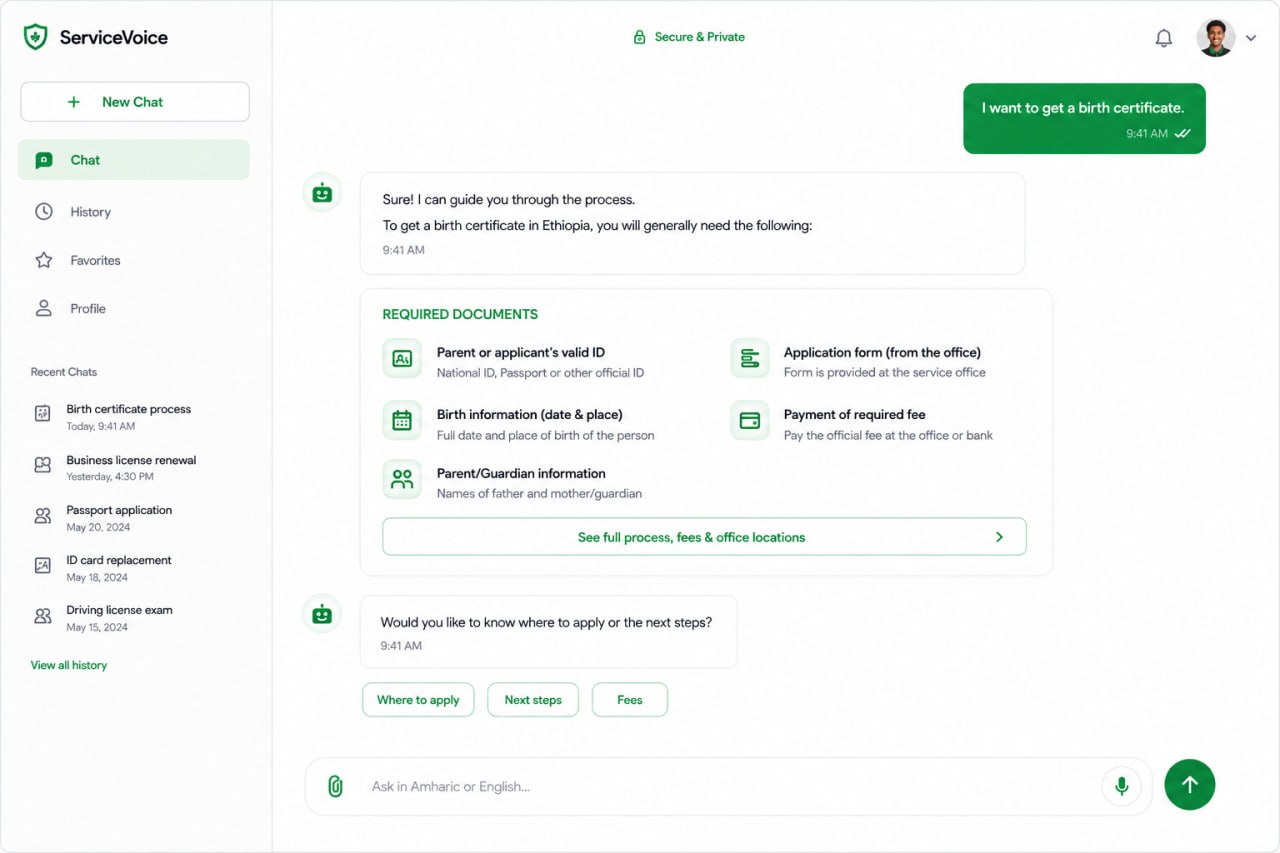
The Solution: The Voice-First Woreda Service Navigator is a deployed web and SMS/USSD platform that tells any Ethiopian how to get any government service — step by step, in their language, on any device. It is voice-first, not voice-only: an illiterate grandmother can speak her need and hear the answer in Amharic via Voxide, while an educated user like Abebe can navigate entirely by text — tapping "Services" → "Renew ID" → "Document Checklist" — with no voice required. Every answer is backed by legal citations from the Scholarxiv MCP server and Papers API. Citizens leave anonymous voice or text feedback that feeds a public accountability dashboard, creating the first structured dataset on how Ethiopian services actually perform. Hosted on EthioDeploy, reaching non-smartphone users via SMS/USSD, and ready for future payments through Links.et (https://links.et/).
The Features: Voice-first interaction (Voxide) with full text navigation as a dual-mode alternative; field-verified service playbooks; step-by-step guided mode; document checklists delivered by voice, text, or SMS; "Why?" answers cited through Scholarxiv; anonymous voice and text feedback; a public accountability dashboard; multilingual support (Amharic, English, Oromiffa); SMS/USSD fallback; offline-capable PWA; and EthioDeploy hosting with Links.et (https://links.et/)-ready payment architecture.
