Documentation
Kiftet — Close the gap
563,500 students sat Ethiopia's 2026 national exam. 87% failed.
Not from missing class. From nobody telling them, before the exam,
exactly which ideas didn't stick. So they study everything, or nothing.
The mechanism:
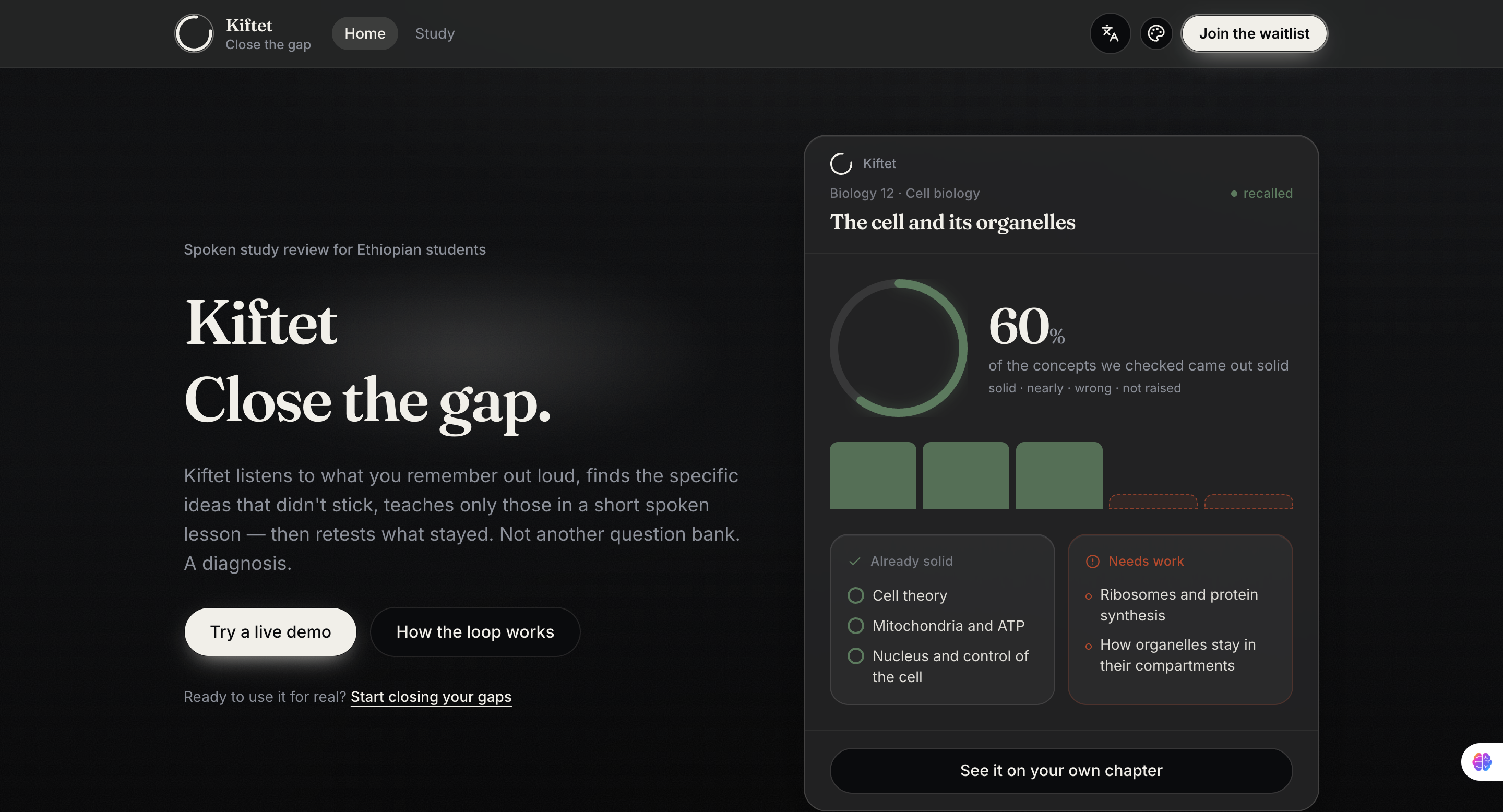
You speak what you remember. Kiftet grades every concept separately right, wrong, raised-but-unfinished, untouched and builds you a study plan from that map: what to fix first, what page of your book proves it, and what to do with the tools you already trust. We don't try to be the place you study. We're the reason you know
where to go and what to do.
Why it's personal, not a playlist.
2 reasons:
1, the onboarding that we will have.
2, The plan is a function of one student's per-concept mastery, so a wrong belief outranks an untouched topic and a half-raised idea outranks both. A question bank has no model of you; this does, and it carries across every chapter and every exam.
Why it compounds.
Every explanation sharpens a shared per-concept map of what Grade 12 Biology students(demo chapter) actually get wrong. That's a research asset grounded in the national syllabus and pre-mapped misconceptions and it gets better with usage in a way a content library never does.
Why it scales.
One student's plan is free for the next. Measured, not promised: cold guide ten AI calls, warm guide zero. On a free-tier budget that is the only way this reaches a classroom.
Built on a Bun/TypeScript monorepo — one Express process serving the PWA, Drizzle on Neon, Gemini behind a single seam. Voxide for voice, EthioDeploy for the deployment, Amharic and English, offline-first.