Documentation
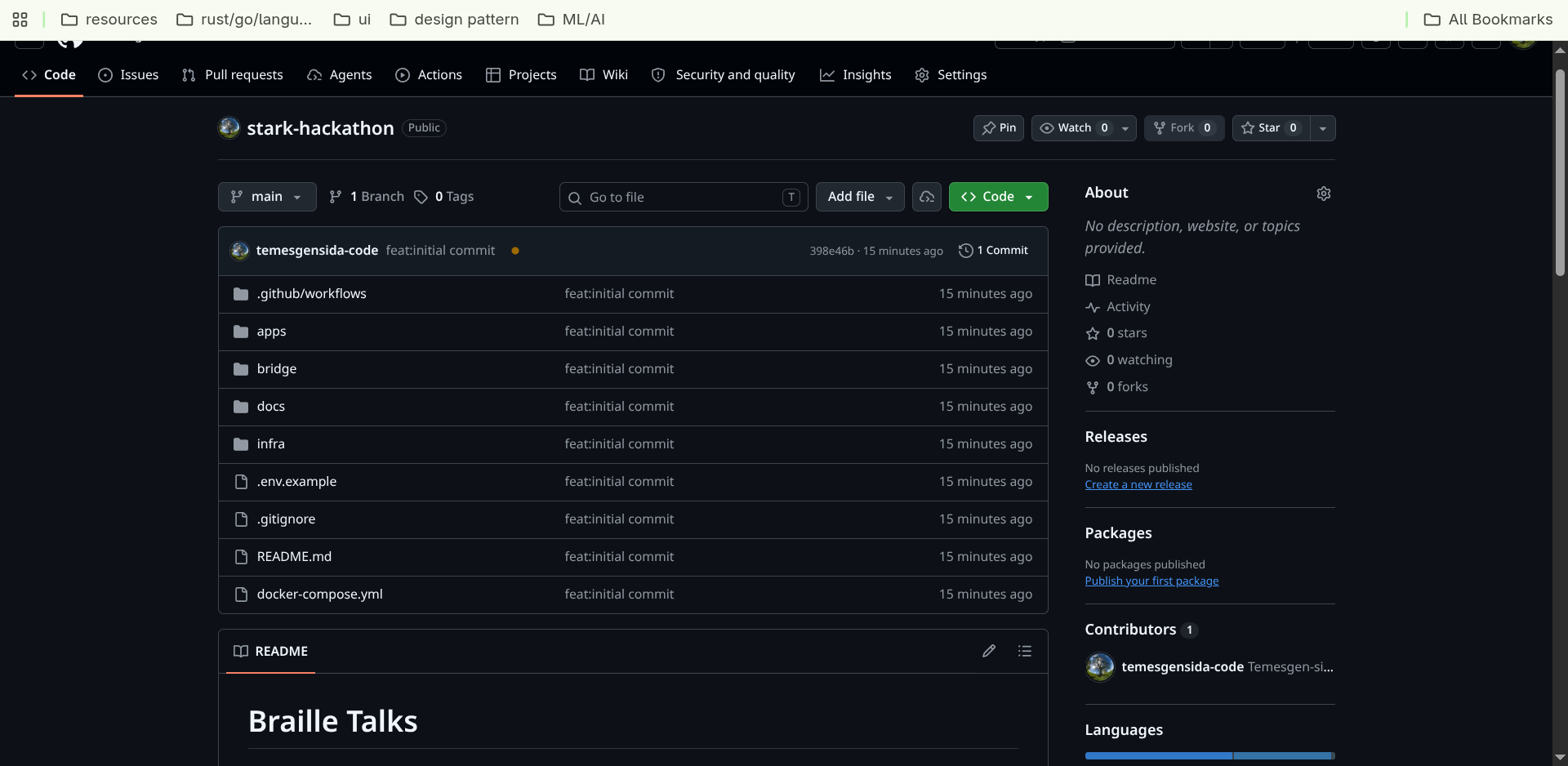
Project Name: braille-talks
Bridging research and accessibility by empowering visually impaired (mainly blind) researchers to explore, analyze, and publish using AI-driven audio and digital Braille display integration.
The Problem
Academic research and literature review rely heavily on visual interactions—skimming dense PDFs, referencing complex citations, and taking structured notes. For blind and visually impaired students and researchers, existing tools fail to deliver an accessible experience. Standard screen readers often struggle with academic structures (e.g., tables, formulas, multi-column paper layouts), and current research platforms lack bi-directional compatibility with hardware refreshable Braille displays.
The Solution
An end-to-end AI-powered research assistant designed explicitly for accessibility. By combining intelligent document analysis with low-level hardware communication protocols(example Liblouis), this platform allows visually impaired users to seamlessly search, digest, and take notes on complex research papers using either voice or tactile digital Braille output.
Key Features
AI-Powered Literature Synthesis: Converts dense research papers ,academic PDFs and braille papers into structured, digestible summaries, section breakdowns, and key takeaway audio streams.
Bi-Directional Braille Translation: Uses Liblouis to perform accurate real-time text-to-Braille and Braille-to-text conversion, enabling users to read outputs and write notes directly via connected digital Braille displays.
Conversational Voice Assistant: Hands-free voice interface allowing researchers to query papers, skip sections, ask clarifying questions, and navigate literature conversationally.
Accessible Note-Taking Hub: Integrated Braille-friendly note editor for capturing insights, managing citations, and drafting research summaries on the fly.
By making academic research tactile and conversational, this tool levels the playing field in higher education and STEM fields. Visually impaired researchers can independently conduct lit reviews, synthesize data, and author papers without relying on visual proxies.
