Documentation
Do you remember those school feedback papers we used to write at the end of the semester?
I don't know about you, but when I was in elementary school, some teachers asked us to write feedback about their teaching methods and overall behavior on small pieces of paper. The class representative would collect them, and the teacher would read them in front of the class. At the time, I used to be brutally honest when giving feedback. One semester, I wrote harsh feedback about a very strict teacher. But instead of accepting the criticism, the teacher collected our exercise books, matched the handwriting, found out it was me, and punished me badly. That moment stayed in my mind for years because the whole point of the feedback system was supposed to be anonymity, yet it was still traceable through handwriting. That was probably the first time I realized how important real privacy is.
Fast forward to this year. For the first time in my life, I started living alone. Most of my days were spent coding at home, and sometimes it got lonely, so I started listening to podcasts and YouTube programs while working. One of the programs I followed was hosted by Leyu & Mahi. Their audience sends personal stories through Instagram, and they discuss them on YouTube while giving advice and opinions. To protect people’s privacy, they usually copy the messages and delete them without checking profiles. But many people, especially women sharing abuse stories or sensitive experiences, still use fake accounts or even their friends’ accounts because they are afraid of being traced. Again, another privacy problem. People want to speak honestly, but they still don’t fully trust the systems they use.
Then there’s the third experience. I spent a lot of time on Telegram confession and vent channels. Later, when I started studying how those systems actually work, I realized most of them are not truly anonymous. Many of those bots store your Telegram ID behind the scenes to connect posts and comments. Which means if the database gets leaked or compromised, your identity can potentially be exposed. People use those platforms to confess, vent, ask questions, seek advice, or simply express feelings they can’t share in real life. But fake anonymity is dangerous because people think they are safe while their identity is still linked somewhere in the backend.
And finally, product feedback. Whenever you launch a project, whether it’s design, software, content, or a startup idea, most people around you say things like “Looks nice” or “Great work,” but very few people give honest criticism. Not because they want to lie, but because people are uncomfortable giving direct feedback publicly. Some don’t want to offend you, some don’t want others to see their opinions, and some simply want privacy. Yet honest feedback is one of the most valuable things creators can receive.
That’s where the idea of AntsarNet started.
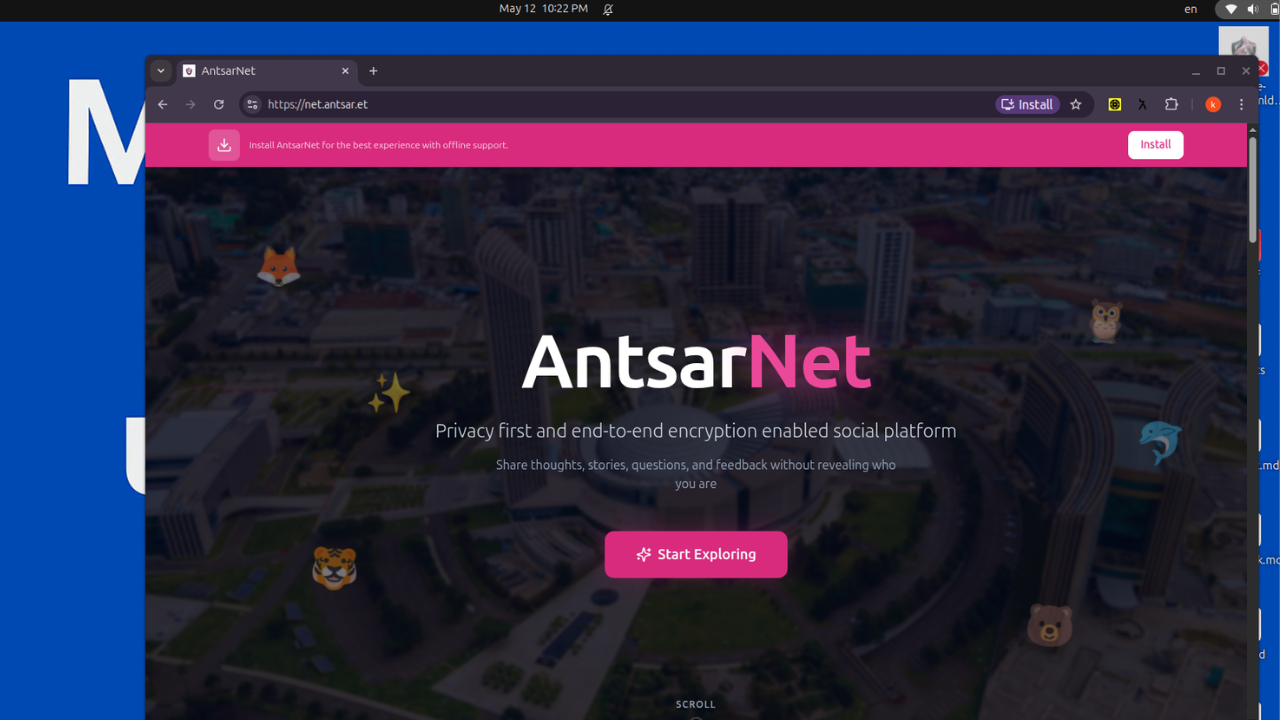
AntsarNet is a privacy-first, end-to-end encrypted anonymous social platform built for honest communication without identity exposure. A place where people can share thoughts anonymously, receive honest feedback, send private stories, vent safely, connect through encrypted chats, and express themselves without linking their identity.
- No fake anonymity.\
- No Telegram linkage.\
- No exposure-first design.
And it’s open source: anyone can inspect the code, verify how it works, and contribute to it. That’s how transparency and real anonymity stay accountable
Even start using AntsarNet by giving us feedback anonymously using the AntsarNet inbox feature: [ https://net.antsar.et/ib/1a64d9a0-bac2-47fa-8bdd-eab22aaa5e53?t=Z2l2ZSUyMG1lJTIwaG9uZXN0JTIwZmVlZGJhY2slMjBmb3IlMjBBbnRzYXJOZXQlMjB2MS4wLjA%3D ]
Github: [ https://github.com/AntsarLabs/AntsarNet ]
----------------------
Built under AntsarLabs by t.me/thekassdag