Documentation
ድረስ (DERES) — Protocol-locked emergency first-aid guidance
ድረስ (DERES) is a multilingual, voice-guided web platform for untrained bystanders in Ethiopia. It runs in the browser on a phone or a computer. It covers the minutes between the start of an emergency and the arrival of professional responders.
When an emergency occurs, the person at the scene is often a relative or bystander, not a clinician. DERES greets and speaks in the language they choose — English, Amharic (አማርኛ), or Afaan Oromoo — then listens. Speech is interpreted by a language model; every medical instruction is taken from a published protocol. The model does not compose treatment.
DERES is not a generic medical chatbot. The bystander names the scene (collapse, crash or injury, possible stroke, choking, severe bleeding, burn, or something else). That choice selects a locked first-minute path, or a 907 call when no protocol applies. Guidance is one spoken question or action at a time. Large buttons run the same path if the microphone cannot be used. Tapping the microphone while DERES is speaking interrupts it so the bystander can answer.
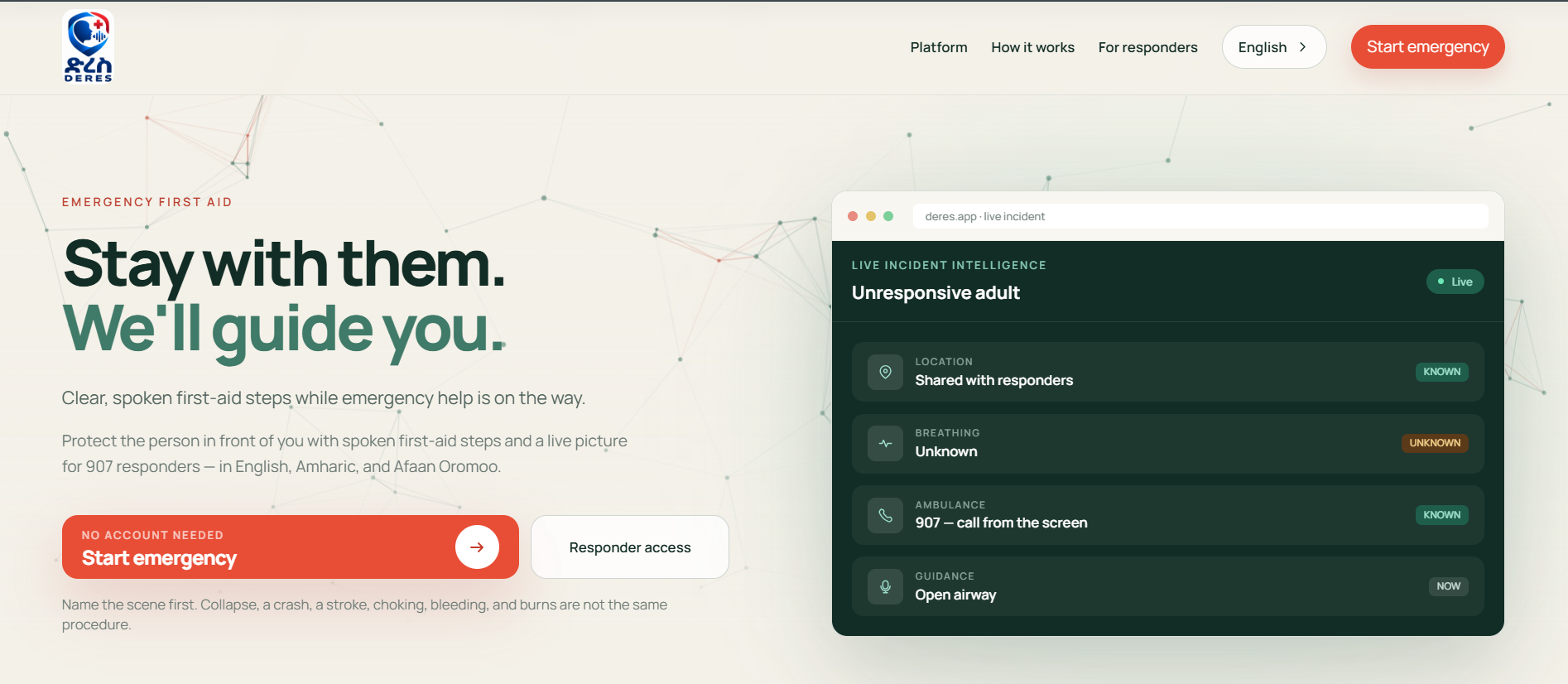
Throughout the incident, DERES records what is known, what remains unknown, and which steps have been confirmed. Location may be shared with the incident. Ambulance 907 remains available on every emergency screen. When professional help takes over, that record is presented as a structured handoff on a responder dashboard: warnings, facts with certainty, actions already taken, and a live timeline.
Core capabilities
- Web application for phones and desktops (no native app install required)
- Voice-first bystander guidance in English, Amharic, and Afaan Oromoo
- Protocol-locked first-aid (six first-minute paths; wording is not invented)
- Voice or large buttons — both follow the same protocol
- Persistent ambulance 907 call from the emergency screen
- Real-time incident state (known facts, unknowns, confirmed actions)
- Structured timeline and professional responder handoff
- Responder dashboard for live incidents
DERES does not replace emergency services or medical professionals. It does not diagnose, prescribe, or dispatch ambulances. Its purpose is to guide the person already on scene until 907 responders take over, and to give those responders a clear picture of what has already happened.
